Building phone + TV games
I started on a journey to learn more about game development and explore concepts that would make it easy to enjoy social games in-person.

Roles
Product Design, React Native Development, Prototyping, User Testing, 0-1 Product Strategy, Marketing & Branding
In Brief
Studied the inner workings of the gaming industry; Learnt React Native + how to build games with it; Built a trivia game called “Trivia Dash” which can run across smart TVs and the web; Explored starting a company; Went through the Antler Residency program and received funding from the Canada Media Fund to explore an initial concept
Results
Finished Trivia phone + TV game that is ready to launch
I wanted to shift my career to align with my interests and try something new. Getting back to designing and building products hands-on. This decision started with a desire to make in-person social gaming more spontaneous and accessible.
Problem
I observed so many awesome moments playing phone + tv games with friends. The medium was a simple way to get everyone to participate; you only need your phone. However, I observed that these moments didn’t happen often among my friends. My theory was that these games are easy to play once you get going, but the complexity of setup and lack of discovery get in the way. You typically need a console / PC to play, and you find the games through game stores that aren’t familiar to most casual/non-gamers.
Goal
Bring social games on TV that non-gamers will want to play.
The video above shows the game near completion (video sped up 2x). This smart TV game can run across most devices, including Apple TV.
Process
Before diving into the process I had several user interviews to discover how people entertained a group when they were in-person. I undercovered key insights that confirmed some of my initial hypotheses - users had tried many games and enjoyed them, but nothing stuck. There wasn’t a consistent product people came back to for these kinds of games, unlike the gaming patterns you see on consoles or even casual mobile games. It presented a unique opportunity for this category of games.
I first conceptualized a mobile app that leverages screencast technology to cast various party games onto your TV. However, due to the technology's limitationsy and waning support, it became clear that a smart TV app would be needed.
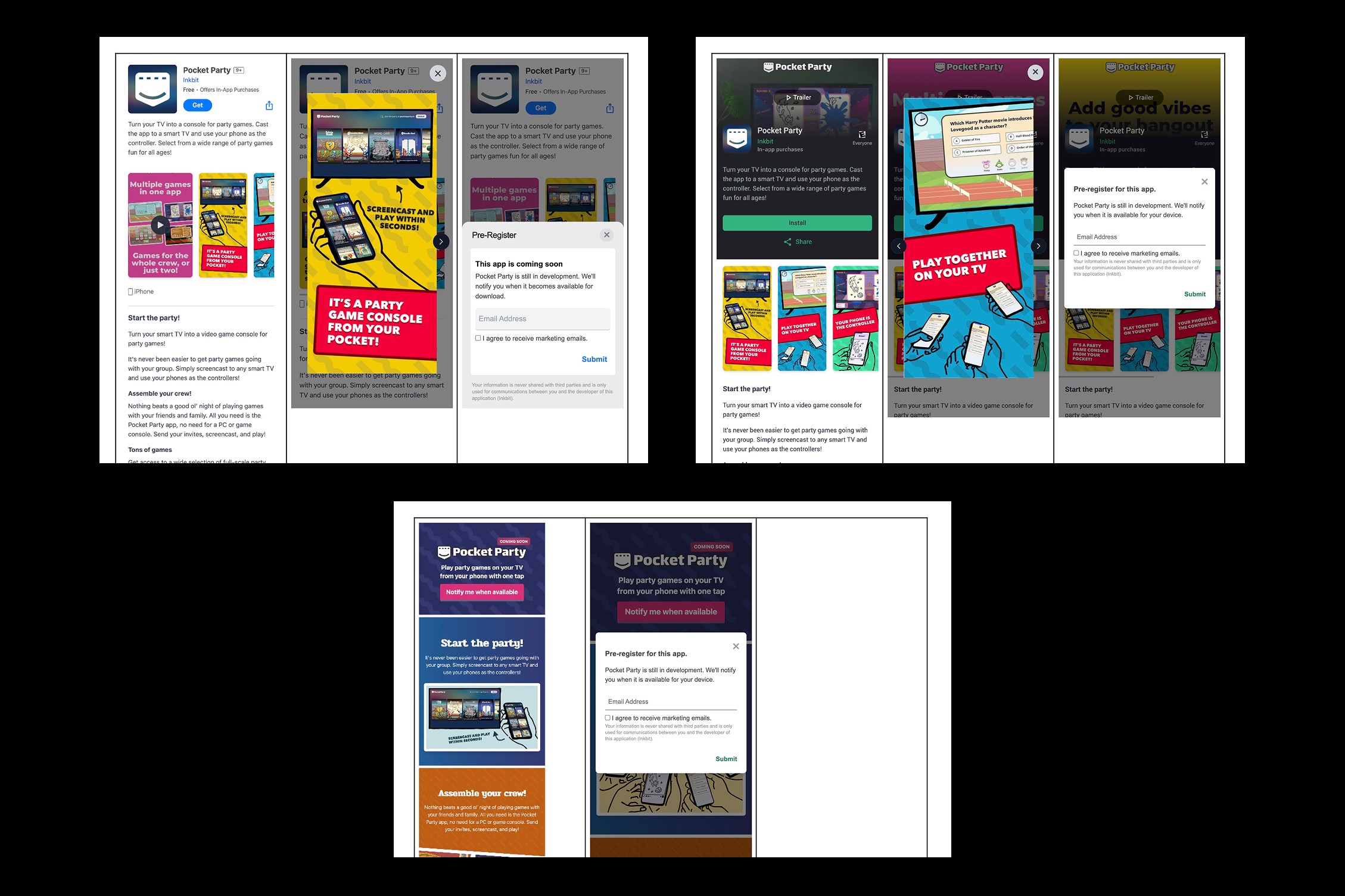
Before starting development on a smart TV app, I wanted to get further validation, so I created a qualitative experiment. I designed and built a generic landing page and emulated app store pages (based on the user’s device), where I could split test traffic from Snapchat & TikTok. I saw good CTR and conversion rates - this, combined with the market validation from competitors already in the market, were positive indicators.


I worked closely with a freelancer to produce game concept art for several games. These were used in graphics for landing pages and other promotional material.

Creating one app containing multiple games was ambitious, so I scaled down my approach to first try and build one game with multiplayer support. First a prototype would be created, then work on a production version. I spent time architecting and building the prototype with an experienced developer. From this, I learnt what a scalable, solid development pattern would look like to pull off this app.

I created mockups for the trivia game and components that would be used throughout the interface.
Above is a video walkthrough of the prototype (video sped up 2x). It features two controller types: a multiple choice selection or a buzzer button.
Several rounds of playtesting were done to refine the game. This process allowed me to learn a lot about game design and what excites users. The simplest changes like adding rounds or sound effects seemed to have a significant impact on player excitement.
One key learning point from playtesting is that the controllers need to be simplified greatly. I noticed that if the display is too information-dense, users will spend more time looking at their phone. This went against my goal of creating a game that has users looking around, interacting with other players and focusing on the display screen.
During my time at Antler Canada's Residency program, I explored this concept further, evaluating both the product development approach and whether venture capital funding aligned with my goals. While the program provided valuable insights, I ultimately decided against building a company. Instead, I committed to developing a production version of the app independently as a solo developer. I remained determined to experience the entire process firsthand and ship a complete game from start to finish.
With React Native, a multiplayer framework, and some determination, I designed and built Trivia Dash. Along this journey, I became a student of the games industry and am eager to keep learning more. I also greatly improved my React development skills.
